
Shaina Rainford Built One of the Most Powerful Haircare Businesses in America Without Building a Fragile One
Updated: Sep 3
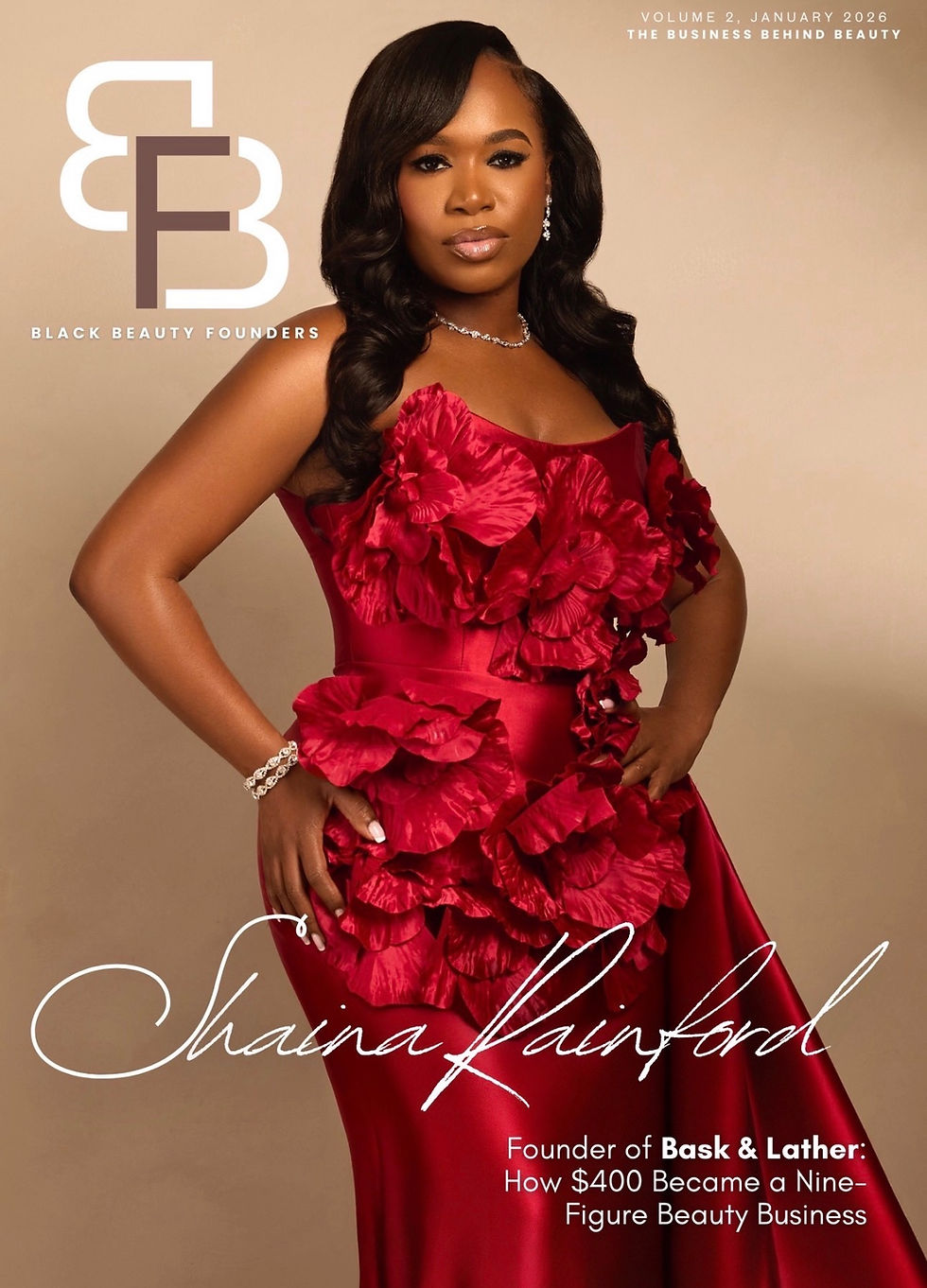
Shaina Rainford does not fit the beauty founder archetype the industry likes to reward.
She didn’t raise venture capital. She didn’t chase celebrity endorsements. She didn’t rush into national retail to validate the brand. And yet, in just over five years, she built Bask & Lather into a nine-figure business, largely on her own terms.
The origin story begins not with a pitch deck, but with a medical problem no one could solve.
Years before the brand launched, Rainford’s youngest sister, Aaliyah, lost all of her hair after a severe scalp infection spread across her head. By the time doctors reached a proper diagnosis, the damage was already done. Specialists couldn’t promise regrowth. Her mother responded the way many Black women have learned to respond when the system fails them: she researched, experimented, and created her own solution.

She studied natural ingredients with proven efficacy, developed a formula in the kitchen, and adjusted it until it was usable and effective. That oil worked. Over time, Aaliyah’s hair didn’t just grow back. It grew long, thick, and healthy.
The formula stayed within the family until the pandemic shifted Rainford’s life in a different way.
While working as a nurse practitioner, Rainford contracted COVID and became critically ill. She recovered, but weeks later experienced sudden, aggressive hair shedding. Treatments failed. The loss felt personal and destabilizing, even after surviving something far more serious.
When she turned to the same oil her mother had created years earlier, the results were fast and undeniable.
“I remember thinking, if this is happening to me,” Rainford says, “imagine how many people don’t have answers.”
She began posting before-and-after photos on her personal Instagram account. Demand followed immediately. Orders arrived through Cash App. She delivered products by hand. The pace escalated quickly enough that she realized it could no longer remain informal.
Bask & Lather launched on December 18, 2020.
By March 2021, the business was generating six figures in monthly revenue.
At the time, Rainford was still working full-time in healthcare. Production happened during the week. Products sold out within hours of restocks. Weekends were spent packing orders in her living room with friends and family. Mondays brought another shipment truck, followed by another cycle.

The business was growing faster than her job could support.
After a series of workplace conflicts clarified the tradeoff she was making, Rainford resigned in June 2021.
The growth accelerated.
Today, Bask & Lather operates at nine figures in annual revenue, entirely bootstrapped.
“I started with $400,” Rainford says. “We still have no investors and no debt.”
That decision wasn’t ideological. It was strategic.
Rainford had watched other Black beauty founders rush into retail or surrender control too early, only to lose leverage. Instead, she prioritized cash flow, operational discipline, and direct customer trust. The brand stayed lean. Marketing spend remained performance-driven. Every dollar was evaluated for return.

“Our customers don’t care about hype,” she says. “They care about what the product does.”
When exponential growth arrived, Rainford didn’t celebrate prematurely. She identified the pressure point immediately. Operations. Scaling meant expanding supply chains, securing major U.S. manufacturers, and placing purchase orders in the millions of units. It meant negotiating terms from a position of leverage rather than desperation.
“Operations,” she says. “That’s where everything shows up.”
As Bask & Lather grew, Rainford learned that leverage shifts quickly. Volume changes conversations. Vendors respond differently. Costs move. Negotiation becomes less about asking and more about anticipating what the business will need next.
“At a certain point, vendors don’t have the leverage anymore,” she explains. “You do.”
She is candid about learning, sometimes too late, that underestimating future growth can limit upside.
“You have to think ahead,” Rainford says. “Learn business. Stop building like you’re grateful to be in the room. Build like you belong there.”
The same decisiveness shaped Bask & Lather’s rise on TikTok.
In 2023, Rainford hired her first social media manager. It was her teenage son, Jayden, who noticed something wasn’t clicking. At the time, he was fifteen. He didn’t know women’s hair. He didn’t know the category the way she did. And she told him exactly that.
“I told him, you don’t know anything about women and you don’t know anything about hair,” she recalls. “So how could you run my TikTok?”
But Jayden wasn’t coming from theory. He was already running a business of his own with Rainford’s brother, posting content that consistently went viral. He understood pacing, hooks, repetition, and how people consume content online.
“I realized he wasn’t looking at the product,” Rainford says. “He was looking at behavior.”
She let him take over for the summer. What followed wasn’t a single viral moment, but sustained performance. Video after video crossed into the millions. Engagement turned into sales. Content became a system.
“There was no waiting to see if it would work,” Rainford says. “We jumped on it, got success, and replicated it.”
One video in particular, the now-legendary wall test demonstrating the strength of the brand’s edge control, spread across platforms overnight. It wasn’t spectacle. It was proof.
But Rainford refused to let platform success become platform dependence. When uncertainty around TikTok surfaced, she diversified aggressively. TikTok, once nearly 40 percent of revenue, now accounts for roughly 15 percent.
“We never keep all our eggs in one basket.”
The majority of revenue comes from direct-to-consumer sales, supported by Amazon, Walmart Marketplace, and selective wholesale distribution. Rather than rushing into mass retail, Bask & Lather sells directly to beauty supply stores, particularly smaller and Black-owned retailers burdened by distributor minimums and unfavorable terms.

Removing the middleman allows those stores to order sustainably while preserving margin.
It’s not charity. It’s strategy.
Education remains a core pillar of the business. Rainford understood the importance of scalp health long before it became industry shorthand for “skin care for the scalp.” But she also understood that education has to be delivered in ways people will actually consume.
“Nobody wants a boring educational paragraph,” she says.
Bask & Lather earns attention first, then educates through live shopping, email, SMS, and content that builds trust in real time. The brand goes live for hours daily, answering questions and converting credibility into revenue. Rainford originally hosted those sessions herself from the warehouse while packing orders.
Even as the company grows, she remains deeply involved.
“There isn’t a check that leaves the business without my sign-off,” she says.
Outside the business, Rainford is raising three children, including a newborn. When asked about balance, she doesn’t soften the truth.
“There’s no balance,” she says. “There are tradeoffs.”
Her answer is structure. Senior leadership. Documented processes. Systems that reduce dependency on her presence without weakening control. She expects that transition to stabilize within the next four to six months.
When asked about the future, Rainford doesn’t hedge.
“We’re going to be the number one textured hair care brand.”
She says it plainly. Like someone who already understands the math.
And we believe her.


Comments